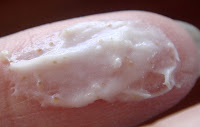
When steel parts are laser cut, heavy slag can develop on the part. These burrs are typically much thicker and heavier than a normal burr or sharp edge and can sometimes be a large a 1/8″ thick. Removing this excess metal requires an extremely aggressive operation. For this piece, part-on-part barrel tumbling was required to knock off the extraneous material.

To keep the cycle time to a minimum (less than 8 hours in this case), a hard abrasive grit, Silicon Carbide, was added to increase the deburring properties as well ‘even out’ the surface finish. After tumbling the part showed no burrs or slag on the edges and had a uniform, matte finish.
After this ultra-aggressive deburring step, the parts can then be tumbled (barrel or vibratory) to improve the surface finish for further processing.
The Steel Structures Painting Council (SSPC) has designated fifteen different surface preparation standards including simple solvent cleaning (SP-1) to Commercial Blast Cleaning (SP-6) to Industrial Blast Cleaning (SP-14). Some of these standards are simply visual while others designate specific profiles. These standards are applicable to a large variety surfaces. If a specification has not been designated for a surface to be cleaned or blasted, using an SP standard will provide consistent results from part to part and job to job.
When it comes to abrasive blasting the more air you have the better. While the amount of air needed depends on the a variety of factors including the nozzle size and blasting pressure. How do really know how much air your compressor is generating.
Compressors will often have a data plate that identifies the air volume (cfm) generated at a specific pressure (psi). This information is a good step towards identifying how much will be available at the actual blasting pressure. The actual cfm generated is generally less than the stated amount even when factoring in changes in psi.
A good rule of thumb is that the each horsepower will generate 4 cfm of air at 100 psi. To get these results, the tank size should be at least 1 gallon for each cfm generated by the compressor.
Piscataway, NJ • Kramer Industries isn’t immediately recognized as a military supply company. However, as a leading supplier of cleaning and polishing media, chemical compounds and vibrating equipment, Kramer has been silently playing a vital role in the preparation of military parts for decades. Case in point is the contribution Kramer makes to the output of Check-Mate Industries, a New York-based, cutting-edge tool and die company, and internationally respected OEM supplier of military parts.
“We’ve been helping Check-Mate transform raw steel into finished components for military use for many years,” says Steven Schneider, sales manager of Kramer Industries “They not only make innovative use of our corn cob grit and vibrating equipment to deburr and polish steel parts, but Check-Mate has also pioneered the use of our chemical compounds to hasten and enhance the process.”
According to Schneider, Kramer Industries has developed a wide range of chemical compounds to complement their line of grit media. “Each of our compounds has a specific function in the finishing process,” says Schneider. “Some are abrasives, some polishing agents, others are formulated for corrosion removal, and still others for degreasing and corrosion prevention.”
A spokesperson for Check-Mate Industries confirmed the long-time role of Kramer compounds in her company’s day-to-day operations. “Kramer helps us choose the right compound from their line for each step in our parts preparation process,” says Jackie Vieweg. “Our requirements are very exacting,” explained Vieweg, “and Kramer personnel have been willing to work hand-in-hand with us to perfect our processes.”
There are two ways to abrasive (sand) blast using a portable system – pressure blasting and suction or gravity fed blasting. Both systems have advantages and the choice is based on the application and the usage. A variety of dry blast media can be used with either blasting method. As always, it is important to make sure the nozzle size being used is proper for the media grit size being blasted.
Suction or gravity fed blasting involves sucking or pulling media from an open container using a blast gun. The air jet inside the gun passes high velocity air over the media pick-up hose ‘pulling’ the media out of the nozzle with the air. This type of system is inexpensive and simple to use but the process is inefficient and takes a long time. This type of process is designed for small jobs.
Portable pressure blasting requires loading a pressurized pot with media that is forced through the hose and the nozzle. These types of systems are designed with a wide range of pot sizes (with a large cost range) and can be used with many different sized nozzles. Pressure blasting is very efficient and is the absolute choice for industrial and commercial (heavy duty) blasting applications. For industrial-grade portable pressure blast systems we prefer ALC.
Question: I’m interested in ceramic and glass sphere media for tumbling compressed gas cylinders to remove rust and organic contaminants. I want to clean these cylinders for oxygen service. My cylinders range from large (5′ tall by 10″ diameter) to medium (2′ X 7″) in steel to small (1′ x 4″) in aluminum. I’m primarily interested in doing a thorough job cleaning the cylinders without damaging them.
Response: The following recommendations would be appropriate:
This final installment of the Abrasive Blasting Media series will discuss the merits of using both Steel Shot and Steel Grit for blasting. Both of these media types are produced from scrap steel which is melted, modified and then solidified into a generally round shape (Shot) or angular particles (Grit).
Steel Shot produces a very smooth finish on the surface of metals. The rounded shape does not strip a surface very effectively but rather peens the surface to produce a clean, smooth and (sometimes) polished finish. The smaller the shot the better the polish but the less aggressive the peening operation. The peening action of the shot is also used to impart compressive strength or hardening to metals.
Steel Grit is used when aggressive stripping action is required. Steel is softer than Aluminum Oxide so will not fracture as easily but the higher density produces a forceful blasting process. Smaller sizes and softer formulations of grit are used when lighter cutting is required while larger sizes and harder steel formulations will maintain the particle angularity and a high strip rate.
Since both Steel Shot and Steel Grit have a high bulk density of about 250 pounds per cubic foot, special or modified equipment is necessary to blast these media using air pressure alone. Steel is often used in wheel blast operations where the media is propelled by a wheel using controlled force.
Traditional sand blasting and the need for healthy and environmentally sensitive operations meet up perfectly when using Crushed Glass Grit. Glass has the same hardness and other blasting properties as silica sand but none of the inhalation dangers from free silica. Crushed Glass Grit is 100% recycled glass diverting this material away from landfills.
Crushed Glass Grit is available in a wide variety grit sizes making it suitable for many different applications. Coarse sizes can be used for heavy duty stripping of paint, rust and other coatings off structural steel, concrete, brick and other structures. Fine sizes can be used (if careful) on thin metal surfaces such as automobile door panels without warping and even on wood surfaces without etching.
With recent performance and environmental approvals from the military and government agencies, Crushed Glass Grit is increasingly being used as a replacement for coal slag and other ‘dirty’ media. As Glass contains no heavy metals or free silica this media is showing increasing versatility as an economical, consumable blasting media.
Question: I modify stainless steel flatware and dinner service pieces for other uses. In the process of modifying I use heat to bend, cutting wheels, grinding wheels, drilling and some sawing. The pieces are blued from the heat and have grinding marks, cutting marks and holes with burrs. I am presently de-burring and removing grinding and cutting marks by hand. After cleaning up the pieces I polish them to a high shine by hand. I have recently obtained a vibrating tumbler. What suggested media can be used to do the clean up and the polishing? How long would it take to tumble in these processes?
Response: The surface roughness of your parts will determine what media to use. Typically the first step would use a preformed ceramic aggressive cut media (the larger the better) for material removal. The second step would be a general purpose ceramic. Both operations should be done with a nonferrous deburring liquid compound diluted to a proper user strength. The operation should be wet with minimal water or suds. Cycle time are typically 1-4 hours for these deburring steps.
For a bright finish a precision ceramic polishing or steel media can be used. A compound with good lubricity is recommended for this third step. Processing time may be 4 hours with steel media and up to 8 hrs with precision ceramic. For a higher polish and smoother finish, the parts can be tumbled in a pretreated walnut shell grit for 8 to 24 hours for a jewelry quality finish.
Dry ice (frozen carbon dioxide) blasting is similar in many respects to other types of blasting. The dry ice pellets are blasted at a surface to remove surface contamination, coatings, etc. This method is ideal for use with electronics, food processing equipment and areas where moisture and/or grit contamination can not be tolerated.
The Dry ice blasting process is not completely understood. The dry ice sublimates immediately after blasting. The process seems to involve ‘attacking’ the surface contamination with a combination of kinetic energy transfer and microscopic thermal variations at the blasting point. Because of the non-abrasiveness of carbon dioxide very sensitive surfaces can be blasted with little or no affect on the substrate. Due to the sublimation of the media the only residue to clean up is the material blasted off the surface.
Because specialty equipment is required to keep the dry ice cold and the obvious non-reusability of the media, dry ice blasting is an expensive and specialty blasting process. Care should also be taken to make sure that proper air flow is maintained in any enclosed environments as carbon dioxide can build up over time and replace oxygen in the area.
Soda blasting is specialty blasting process that is ideal for applications where damage to the surface is unacceptable. This process was originally developed for blasting the Statue of Liberty. Soda (or baking soda or sodium bicarbonate) blasting is a versatile process used to remove paint, oils/grease, rust, paint and other surface contaminants. Soda will not damage glass or create heat during the blasting process and cause warping of thin metals. If desired and local regulations allow, soda can be washed away after blasting due to it’s water solubility.
Since soda is hydroscopic (a ‘love’ for water) it will have a tendency to clump and flow improperly. To minimize this issue, special equipment is required that is dedicated for soda blasting. Also, specialty soda formulas for blasting (not the standard stuff in your refrigerator) have been developed to improve the media flow properties.
Unlike other dry abrasive blast media, if the surface being blasted is sensitive to chemicals or the surface will be coated after the blasting a rinse with water or a water/vinegar solution will be required to neutralize the soda.
Plastic Abrasive Blast Media (PABM) are considered specialty media that are typically used in very specific applications. There are three primary types of PABM that are differentiated by their hardness; although, all of these media are considered softer and less aggressive than more popular blast media. PABM are manufactured to meet the military specification MIL-P-85891-A which details the different types.
Urea (Type II) is the most popular plastic abrasive media. Urea is typically used for auto paint stripping. Urea is a soft media {in between Melamine (Hardest) and Acrylic (Softest)}. Urea media can be used for mold and tool die cleaning/stripping.
Melamine (Type III) is typically used when a technician is not as concerned about the surface finish of the substrate relative to blasting cycle time. Melamine offers the quickest strip rate of all three PABM. Melamine media also breaks down the quickest of the three.
Acrylic (Type V) is the least used of all three medias. Acrylic is a truly specialized media and is used for applications like fiberglass, boats, helicopters and aircraft. Acrylic media will last the longest of all three medias.
You don’t have to be a marksman to know that the more you shoot, the keener your target shooting skills become. However, the cost of ready-made ammunition has shot through the roof over these last several years, which explains the growing popularity of recycling or “reloading” spent cartridges; cleaned and polished with walnut shell or corn cob grit.
“If you want to get more bang for your buck on the firing range, it’s just a matter of picking up after yourself,” says Steven Schneider, sales manager of Kramer Industries, a leading supplier of cleaning and polishing media and vibrating equipment used to recycle cartridge shells.
According to Schneider, “First you remove the dirt and gun powder marks from your cartridge. For that, you need a vibratory bowl machine and the right grit for the cartridge you’re polishing. We carry walnut shell grit made of crushed shell, and corn cob grit, obtained from the hard woody ring of the cob. The correct media and size of the grit depend on the type of firearm and caliber size.”
George Petronis, owner of The Gun Shop in Vincentown, NJ, says it breaks down to cleanup, resize, and reload. “Most casings are made of brass, a malleable metal, soft enough to clean and polish without much effort, then resize for your chamber,” explains Petronis, a gun enthusiast and distributor of ammunition to law enforcement agencies from New Jersey to Virginia.
In addition to the cost saving benefits of cleaning, resizing and reloading cartridges, firearm enthusiasts point out that using a vibratory machine and grit allows for a much more thorough cleaning. They also like the idea of being able to customize their load when they recycle, increasing the amount of gunpowder for additional acceleration, or choosing heavier or lighter grain balls.
“Beyond the ability to clean more thoroughly and make sport shooting more affordable, there’s a lot of self-satisfaction involved in the process of reloading for many of our customers,” says Kramer Industries’ Schneider. “It’s a pleasurable pastime that pays them dividends every time they go out to the range.”
Question: I am needing to strip 80 years worth of paint from some fluted wood columns. The columns are in good condition and worth saving if I can remove the paint effectively. What media and grading do you recommend? How much media do I need?
Response: Corn cob grit will be the best option to protect the wood from being etched or ‘raising’ the grain. If the paint is too difficult to strip using this media then a Fine Walnut Shell Grit will be a better option taking care to protect the wood surface. Depending on how difficult it is to strip the paint I would conservatively suggest 2-3 pounds per square foot will be required.
Slightly edited from the Shop Talk Forum.
With another new year around the corner, another chance to identify opportunities to improve processes has arrived. The dire financial news and global downturn has lots of companies and people putting their heads down to try to ride out the recession. In fact, NOW is the time to look at everything you are doing and figure out ways to makes things more efficient and productive.
Do you have systems that need to be upgraded? Would some form of automation allow you to move people into more productive areas of the operation? Are you spending your time and money to simply maintain your current business or to identify new products and opportunities? How can you improve your product or service offering and create a remarkable experience for your customers?
Now is the time to review everything in your operation (from marketing to production to bookkeeping to …)! Opportunities are everywhere – even inside your business. Go find them and create growth for you and the business. Here’s to an exciting 2009!!
A natural, organic blasting media like Corn Cob Grit provides unique properties and performance. Corn Cob Grit blasting media is extracted from the ‘woody ring’ core of the cob (it is not the entire cob ground up). The wood-like material is a very soft (Mohs 4) medium that also includes an ability to absorb moisture.
Corn Cob Grit is ideal for blasting delicate surfaces. It will strip paint, coatings and soils off many surfaces without impacting (etching, etc.) the substrate. Log home blasting (soft media; effective strip/clean rate), mold remediation (absorbency; strip rate; organic) and paint stripping (soft media) off wood surfaces are three predominant applications for blasting with Corn Cob Grit. Compared to high pressure washing, blasting with Corn Cob Grit leaves the surface dry and ready for immediate application of a sealant or coating.
While Corn Cob Grit can be recycled as many as 4-5 times, it is important to make sure that the collected media is clean so that damage to the blasted surface does not happen during re-blasting. Available in a variety of grit sizes, Medium and Fine are certainly the most popular.
Interesting fact: Corn Cob Grit is used for absorbent/drying applications such as soaking up wet ball fields and oil spills.
Preserving the natural beauty of a log home is a labor of love for most of the half million American homeowners who live in log homes. It’s also labor intensive, even with a power washer in hand. However, Kramer Industries has come up with a solution that now makes it easier to restore log homes – corn cob grit blasting media.
“Allowing dirt and debris to collect on log homes leads to moisture build-up that can cause a home to simply rot away,” explained Steven Schneider, sales manager of Kramer Industries. “With over 30,000 new log homes being built annually, there’s been a growing need to find a better way to maintain these homes without damaging the wood surface. Corn cob grit has proven to be the way to go,” says Schneider.
Log home owners seem to be in full agreement. Take Rob Nichels, who built his log home in a little town called Heuzelton, close to the St. Lawrence River in Upstate New York. He found out about corn cob grit blasting, and found Kramer Industries, on the Internet.
“Build a home with your own two hands, and you take a lot of pride in the roof over your head,” says Rob. “My wife and I just weren’t happy with the results we were getting using a pressure washer, so I went online, researched a few companies, and went ahead and bought a portable pressure blast system from Kramer Industries. It looked brand new when we were finished, and we didn’t have to waste a river of water to get the job done. We even put tarps down, screened out the dirt, and recycled most of the grit for our next cleaning.”
According to Kramer Industries personnel, some log homeowners are using corn cob grit on their interiors. “You only need to use corn grit every two or three years for interiors,” says Schneider. “It is silica-free, biodegradable, and highly cost effective. Log home owners remove or cover their furniture and anything else that could collect the used media before they blast. The only variable is which of our five grit sizes to use, which depends on the condition of the home and the degree of cleaning that’s required.”
How commonplace corn cob grit becomes may depend on the future of the home market itself. The American Institute of Architects says that log homes already account for 9 percent of the custom homebuilding market in this country. So companies like Kramer Industries may need to prepare for more and more homeowners acquiring a taste for corn. Meanwhile, people like Rob Nichels and his wife have never felt better about living in a home made of logs.
Walnut Shell Grit is a fascinating material for blasting. The hardness of Walnut Shell puts it in between the soft medias like Plastic and soda and the more aggressive, common media like Crushed Glass Grit and coal slag. The combination of this hardness (MOHS – 4.5) and the angular shape provides for a decent strip rate with little to no affect on the sub-surface being blasted.
Applications such as aircraft, automotive and boat stripping can be accomplished successfully without risk of etching or warping the metal or fiberglass. Removing paint from brick, steel, aluminum and even wood can be accomplished with very low probability of damage to the underlying substrate. And if kept clean, Walnut Shell Grit can be re-used a number times increasing its value as a blasting media.
Sourced from the leftovers after extraction of the walnut meat, the shells are crushed and graded to a large variety of size distributions. This organic and biodegradable media is ideal in environments where safety and waste disposal are an issue. While the larger grit sizes (+60 mesh) are used in blasting, the finer ‘flour’ grades are used in a variety of applications including cosmetics and personal care products.
There was a time when elbow grease was the only way to restore silverware to its original luster. Today, the upscale food service industry depends on tiny stainless steel balls to do the job for them, and Kramer Industries has led the way in perfecting the equipment and the process that makes it possible.
“We used to clean our silverware by hand,” says David Bango, service director for the exclusive Rivers Club in Pittsburgh, PA, “But never with the results possible with our barrel-tumbler using stainless steel shot as our burnishing media. Unless they are very deep, we can repair nicks and scratches in just one 25-minute treatment, and every piece comes out looking like new.”
According to Steven Schneider, sales manager of Kramer Industries, commercial burnishing systems are referred to as barrel-tumbling systems because silverware is tumbled in the barrel of the machine. “The tumbling action causes the stainless steel balls to roll, or flow into the nicks and scrapes of the silverware,” says Schneider.
“There are a number of options when it comes to burnishing machine size,” explains Schneider, “depending on the volume of silverware a restaurant or caterer needs to restore on a regular basis.” The Kramer Industries K Series is a floor-model size unit and was designed for large volume use. The K14 Series commercial barrel finishing system is a smaller bench or tabletop model. Both are excellent machines for commercial use, and both can use stainless steel shot as the tumbling media.
Kramer Industries recommends stainless steel shot for silverware cleaning and restoration because the particles are substantially heavier than other media, which reduces tumbling time. Stainless steel shot along with an appropriate tumbling compound such as Kramco 910 also eliminates the need for rust inhibitors.
When asked if burnishing was cost effective, Bango answered yes without hesitation. “Since we have the machinery, we restore our entire inventory of silverware every month. Our standards are extraordinarily high here at our club.”
The Rivers Club is part of the ClubCorp family of private clubs, with membership requiring sponsorship by an existing member. According to Bango, “Our members represent business and community leaders throughout the Greater Pittsburgh Area, all of whom are committed to promoting traditional values of community service and good business. Our club plays a unique role in that process and our entire staff takes that responsibility very seriously.”
Air blasting with either Steel Shot or Steel Grit provides a couple of unique challenges. Because of the weight of the media (2-3 times ‘standard’ abrasive blast media), it is important to check with the manufacturer to make sure that your blasting system is designed to handle this media. Many pressure systems are OK but siphon or suction systems will probably have some issues.
Clean and dry (and I mean dry) air is critical for air blasting with steel shot or grit. If moisture gets into the pressure pot, the steel can rust over time reducing the effectiveness and requiring more frequent replacement of the media. If the steel media is left in the pot overnight with moisture you will probably need to purchase a new blasting pot.
Plastic Abrasive Blasting Media is a synthetic media that is available primarily as three different types – Urea (Type II), Melamine (Type III) and Acrylic (Type V). Plastic Media is a dry, thermoset plastics that is specifically designed for specialty applications such as automotive and aviation for stripping (without warping the metal), boat stripping, die and mold cleaning and other sensitive surfaces where etching could be a problem.
Plastic abrasive blasting is a very low dust application. While having a high re-usability rate, plastic media will break down during use into particles that maintain a sharp angular shape adding to the long-life and value of this media. The higher purchase cost of plastic media makes it difficult to call this media an abrasive blasting work-horse but in the applications where surface and part sensitivity are critical, plastic media is definitely the way to go.
Properly produced plastic abrasive media is manufactured to meet the MIL-P-85891-A specification which identifies the various Types.
We are currently experiencing issues with our website. Please email us at [email protected] or call 732-650-9599. Thank you for your understanding.