June 9, 2009
Silicon Carbide
Silicon Carbide is manufactured from a high heat reaction of silica sand and carbon. While silicon carbide and silica share similar chemistry, Silicon Carbide used in abrasive blasting contains less than 1% free silica. Free silica or silicon dioxide is the compound that should be avoided (due to risk of silicosis) and not inhaled as a fine particulate. Details about Silicon Carbide can be found on a previous post.
June 4, 2009
Blasting Stone with Sand
Question: I am thinking of purchasing a small business doing stone engraving. My only concern is blasting with the silica sand which is what is being used right now. We plan to use a blasting room and filtered breathing system but I don’t know how safe I can be using silica sand. I am curious about alternatives like silicon carbide and aluminum oxide and could use any tips and advice on how I can do this kind of work safely.
Response: Blasting with silica sand is definitely NOT recommended – even with a breathing apparatus. Both Aluminum Oxide and Silicon Carbide are more aggressive blasting media than sand and will provide quicker results and a better surface finish on stone. Both of these media can be used with standard abrasive blasting systems without modification. Of course, always minimize breathing any kind of dust when blasting.
June 2, 2009
Steel Bluing
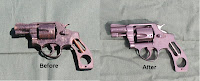
The process of bluing steel creates a micro finish on the steel surface to prevent corrosion and rust. Putting this type of finish is very popular with guns as the process improves the surface finish, protects it and reduces the glare off the metal. While not nearly as durable as plating or painting, bluing is an inexpensive and simple surface finish.

There are a few different ways to blue a surface but all involve creating a very thin ‘coating’ of iron oxide on the surface. This coating prevents oxygen from further attacking the steel. This is similar to the way the green ‘coating’ (copper oxide) coating on the Statue of Liberty protects the underlying copper. Bluing gets its name from the coloring of the iron oxide (magnetite) the process creates. This is a different chemical compound than the reddish color typically associated with rust (also iron oxide).
May 28, 2009
Polishing Brass Cartridges
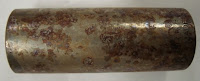
Firearm ammunition reloading is becoming a much more popular pursuit for passionate shooters. This process requires cleaning and polishing the spend cartridges prior to the actual reloading. The brass casings below spent a significant amount of time on the outdoor range prior to collection. In addition to the powder residue and dirt on the shells, the brass showed significant oxidation and tarnishing.
Oxidized and dirty brass shells
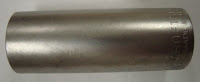
After vibratory tumbling with high alumina, polishing Precision Ceramic Spheres and a mild, organic acid cleaner (Kramco 1030) for only 20 minutes, the brass looked nearly brand new. Additional dry tumbling with Corn Cob Grit or Walnut Shell Grit result in an even brighter finish.
Polished brass cartridge shells
May 26, 2009
Stone Engraving
Question: I am thinking of purchasing a small business doing stone engraving. My only concern is blasting with the silica sand which is what is being used right now. We plan to use a blasting room and filtered breathing system but I don’t know how safe I can be using silica sand. I am curious about alternatives like silicon carbide and aluminum oxide and could use any tips and advice on how I can do this kind of work safely.
Response: Blasting with silica sand is definitely NOT recommended – even with a breathing apparatus. Both Aluminum Oxide and Silicon Carbide are more aggressive blasting media than sand and will provide quicker results and a better surface finish on stone. Both of these media media can be used with standard abrasive blasting systems without modification. Of course, always minimize breathing any kind of dust when blasting.
May 22, 2009
Kramer Grit Puts The Skid On Slippery Floors
Piscataway, NJ • You need 5,000 pounds of aluminum oxide in less than 36 hours. So who are you going to call?
That’s what Ed Minnix, Senior Project Manager for Quinn Construction was facing when he picked up the phone and dialed Kramer Industries for a special flooring project of which he was in charge. Says Minnix, “They got right back to me and said ‘it’s on its way.’ Sure enough, 5,000 pounds rolled in the next day.”
“We use aluminum oxide more often as a blasting media for restorations,” explained Minnix. “It’s a great substitute for sand when you’re removing dirt, rust or other build-up of surface material. However, this time we needed a huge amount of 24-grade aluminum oxide grit to create a highly slip resistant floor coating for a heavily trafficked public area.”
According to Steven Schneider, sales manager of Kramer Industries, aluminum oxide grit has a wide variety of applications, from cleaning engine heads and aircraft turbine blades, to lettering in monument and marker inscriptions.
“Aluminum Oxide is the most widely used abrasive in blast finishing and surface preparation because of its cost, longevity and hardness,” says Schneider. “It will even cut the hardest metals and surfaces, and unlike sand, it can be re-used. However, it is becoming the media of choice among some of our more innovative customers who use gritty aggregates to create non-slip flooring and pavement.”
Through its innovation, and adherence to strict quality control standards, Quinn Construction has become an industry leader in protection and restoration services over the last 20 years. The company services clients throughout the Northeast and Mid-Atlantic States from its Folcroft, Pennsylvania facility.
Kramer Industries offers specialty cleaning equipment and media for a multitude of uses. Its line of media includes corncob, walnut shell grit, crushed glass, plastics, pumice, silicon carbide, steel grit, steel shot and aluminum oxide. When it comes to aluminum oxide, Kramer Industries recommends using virgin, brown aluminum oxide for optimal performance versus reprocessed or remanufactured product. “Virgin, brown aluminum oxide contains less than 1.5% free silica,” says Schneider, “and is therefore safer to use than sand, as well as less expensive.”
May 21, 2009
Suction vs. Direct Pressure Blast Cabinets
The two basic types of abrasive blast cabinets are suction (or siphon) systems and direct pressure systems. While both types provide reasonable performance and high value, certain processes and applications will be better served with one type or the other.
Suction Blast Cabinets
This type of blast system contains an air jet in the blast gun that passes high velocity air over a media pick-up hose creating a siphon or suction effect. The media is pulled up through the hose and propelled out of the gun to the surface to be blasted. This is commonly used for light production applications and for general purpose cleanup and touch-up work. Suction systems are relatively inexpensive systems to purchase and operate.
Direct Pressure Blast Cabinets
A pressurized blast pot is used to force media out of the nozzle towards the target. The pressurized air pushes the abrasive at faster velocities than suction systems. Many processes can be completed 30-50% faster with a direct pressure blaster. Due to the higher flow rate (and
more force), pressure blasting offers the additional advantage of allowing for lower blast pressures ideal for delicate and sensitive surfaces.
May 19, 2009
Abrasive Blasting Cabinets
The choice of abrasive blasting cabinet needs to made based on the type of blasting being done including the media type and frequency of blasting. The primary benefit of a blasting cabinet versus a portable system is the containment of the media allowing for re-cylcing. Many re-usable blast media are abrasive and demand a durable cabinet construction and heavy duty fittings and nozzles.
A cabinet constructed of continuously welded 14 gauge or thicker steel will provide long-term wear with most blast media. Adding optional rubber mats (if available) to the inside of the cabinet will further increase the lifetime of the cabinet. Accessories such as heavyweight gloves and long-lasting tungsten carbide nozzles are also worth the additional expense. A nice addition is an underlayment on the inside of the window to prevent etching of the glass and keep operating costs to a minimum.
The selection of a siphon/suction or pressure cabinet will be described in another post. This decision will impact overall operational efficiency and performance. The blasting cabinets offered by Trinity Tool Company (Trinco) are excellent examples of the proper construction for long term durability and high value.
May 14, 2009
Non-Skid Flooring
May 12, 2009
Crushed Glass Grit Benefits
Crushed Glass Grit offer a number of environmental and performance benefits:
- Sourced from 100% recycled bottle glass diverting material from landfills
- Non-reactive and inert it and can used near water
- OSHA/NIOSH classified as ‘nuisance’ dust
- No silica
- No heavy metals
- CARB approved for outdoor blasting under Title 17
- QPL approved for Military under MIL-A-22262B
- Low embedment in surface
- Can be used in both we and dry blasting operations
- Multiple grit sizes for heavy stripping on tanks, bridges and heavy steel to sensitive blasting on wood, fiberglass and thin metals
May 7, 2009
Cleaning Copper
May 5, 2009
Screen Separating Guidelines
The ability to separate parts from media must be taken into consideration early in the development of the finishing process. Keep in mind that media wears down and should be periodically screened to remove undersized media pieces that can jamb holes.
If one piece of equipment is intended to be used for many jobs, a rotary screen separator would be the closest to a universal machine.
If height space is limited due to low clearance, a flat bed screen separator can be made to fit in a space as small as ten inches high, whereas a rotary screen separator requires a minimum of thirty to forty inches in height.
If limited length space is available, a rotary screen separator can be used since, due to its greater efficiency, it is half the length of a flat bed screen.
If long, thin parts need to be separated, a slotted screen material works best.
If a very small screen opening is required, but a durable material is needed, choose a wire mesh.
If an accurate opening size is needed, perforated metal would be the best choice.
If a crevasse or pocket must be reached, but a large media is necessary to provide the pressure to abrade, use a machine with screens stacked end-to-end or one screen on top of another, allowing multiple items to be separated in one pass.
April 30, 2009
Screen Separating Basics – Part 2
In the first post about screen separators, the different types of separators were noted. In addition to determining the type of separator, it is important to choose a screen type based on the application requirements. Screens can be made of wire mesh, perforated metal or even expanded metal.
Wire mesh is preferred because it has the greatest percentage of open area and an irregular surface to which flat parts will not cling. The wire mesh can have a square opening or a slot mesh. A slot mesh is made with one or more parallel wires eliminated in one direction, yielding a rectangular versus a square slot opening. This creates a greater ease of separation when parts are long and narrow. Wire mesh is available in a broad range of wire thicknesses and openings. Very small openings can be obtained using a heavy, durable wire.
Perforated metal has the advantage over wire mesh of being more precise. If uniform openings are needed to separate parts and media that are very close in size, perforated metal screens are the best choice. Perforated metal screens are available with round, square or oblong openings. Due to the nature of the stamping process, the smaller the opening, the thinner the selected metal has to be; this is needed in order to have a reasonable punch life. If a material with the proper opening and thickness cannot be found, specially sized or configured openings can be achieved through the use of a numerically controlled laser or plasma cutting machine.
For applications that have a significant difference between media and part sizes, expanded metal screens are an economical and durable option. Openings on an expanded metal screen are diamond shaped, allowing for quick separation of both round and cube parts, as well as longer, narrow parts. Expanded metal screens may exhibit limitations with parts that have “arms” or other areas that could get caught in the openings and carried around the tube or damaged during vibration on a flat bed screen.
April 27, 2009
Polish Engine Parts
Question: I have a smaller tabletop vibratory bowl that I am setting up to do small parts with. Mostly I am looking at doing carburetor parts to polish the aluminum.What material should I use? I am completely new to this. I’m not looking for a 100% show shine, just shiny aluminum. Any input is appreciated.
Response: A 3-step process can produce a very smooth, polished finish on aluminum parts. A first step using a light cutting plastic media followed by a second step using a polishing ceramic media should result in a smooth, uniform finish. Both of these step are run wet with an appropriate tumbling compound.If a higher polish is required, a third dry tumbling step using walnut shell grit with red rouge or a polishing cream will bring out the shine on the part.
April 22, 2009
Stainless Steel Tumbling

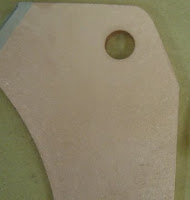
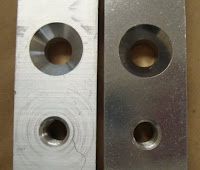
Before and after of machined aluminum part tumbled with Stainless Steel Media. The ‘raw’ showed machine marks, scratches and burrs on the edges. After vibratory tumbling with steel media, the part came out smooth, bright and ready for anodizing. Improved polishing could be achieved by additional tumbling with Corn Cob Grit or Walnut Shell Grit or hand buffing to create a near mirror finish.
April 22, 2009
Kramer Industries’ Grit Helps Preserve History
Piscataway, NJ • Cleaning layers of time off delicate ferrous artifacts used to be the job of electrolysis equipment and wire brushes. But according to historian and archeologist Robert Perry of Pell City, Alabama, the method of choice is now blasting away years of rust, grime and grunge with walnut shell and corn cob grit.
Perry is the president of a full-service cultural resource management firm that assists federal, state, local governments and private-sector firms in compliance with the National Historic Preservation Act.
“Although electrolysis is still required in certain cases,” says Perry, “I now depend on blasting grit from Kramer Industries to get the job done. The people at Kramer helped me select the appropriate grit size and the specific media to be used. In our case, grit made of walnut shells and corn cobs works best.”
Kramer Industries is a leading supplier of cleaning and polishing media, related chemical compounds, and the vibrating, tumbling and blasting equipment specifically designed to take on dozens of cleaning and restoration tasks. Kramer’s line of cleaning and polishing grit includes everything from recycled bottle glass to granulated corn cob, and they work closely with their customers to develop time-saving methods of cleaning and polishing surfaces less abrasively and with little if any environmental impact.
According to Steven Schneider, sales manager of Kramer Industries, “The correct media and size of the grit depends on the size and shape of the objects that need cleaning. We get our corn cob grit from the hard woody ring of the cob, and the walnut shell grit from crushed shells.”
“In the field of historical restoration, grit is now being used to clean everything from nails to rare coins,” says Robert Perry, who has been preserving bits of history for more than 12 years. “All you need is a good piece of blasting equipment and the right grit to remove surface build up without damaging the artifact itself. What used to take hours using electrolysis can now be done in a matter of minutes.”
April 16, 2009
Benefits of Steel Tumbling Media
Given the investment required to purchase Steel Tumbling Media, why use it? It basically all comes down to weight and wear.
Steel media is much heavier than other types of tumbling media. As the parts are forced through the media the high pressure results in reduced cycle times. The pressure or compression on the part helps to work-harden the surface. In many cases, tumbling parts in steel can eliminate shot blasting and lead to parts with increased wear resistance. Work-hardened parts have much less porosity increasing corrosion resistance.
Many parts ready for plating that appear to have a very smooth finish actually have microscopic imperfections in the surface. The weight of the steel media ‘flattens’ irregularities in the surface and produces a noticeably better plated finish – especially with thin depositions such as nickel.
Steel is a considered a non-consumable tumbling media and does not wear down in the tumbling process. This means much longer lifetime than traditional media (100x or more) and no media residue waste from the media.
Steel media should be considered a long term capital investment not a consumable media expense.
April 14, 2009
Glass Bead Tumble Blasting
Large batches of relatively small parts that need to be blasted can be extremely labor intensive when blasting each part by hand. Batching a load of parts together in an automated tumble blasting process will allow for quantities of parts to be blasted all together without the need for an operator’s ‘hands-on’ blasting. Tumble blasting also provides coverage on all areas (3-D, 360 degrees) of the part as the load tumbles under the blast stream.
April 8, 2009
9 Tips for Tumbling Media Selection
9 quick guidelines for selecting the proper tumbling media:
1. Large media will cut faster than small media of the same bond (formulation)
2. Small parts, small media; large parts, large media
3. Flat (vs. round) media will do more work on edges
4. Large media is generally less expensive than small media
5. Soft metals usually demand lighter cutting and lighter weight media
6. Small media will produce a finer surface finish
7. Rounder shapes have more impact on the surface (vs. edges) than flatter shapes
8. Denser (heavier) media will lead to a higher polish
9. More aggressive bonds break down more quickly than less aggressive bonds
April 2, 2009
What is Tumbling Media?
Preformed tumbling media used in both vibratory and barrel tumblers are simply the means to achieving a desired surface finish. The type of media formulation or BOND used can vary widely for each process or application.
Tumbling media is a blend of abrasives and binders. Ceramic Media is generally a clay or porcelain binder while Plastic Media and Synthetic Media are typically made from urea formaldehyde or polyester polymers. These binders are used to hold (bond) and shape the abrasive grit blend needed for a particular media type. Aluminum oxide and silicon carbide are the most popular abrasives used.
The specific type of binder and abrasive used along with the ratio of binder to abrasive will determine the impact of the media on the part. A high abrasive content will lead to quicker break down of the media and a more aggressive operation. Low or no abrasive content will result in a media that is very soft/gentle on the part and used for polishing and fine finishing.
All tumbling media are designed to break down or erode during use. This is necessary to perform the ‘work’ on the part. Generally, the quicker a media breaks down, the more aggressive the bond. The ideal media for any process will provide the minimum erosion (longest lifetime) but must be balanced with a reasonable cycle time to achieve the desired surface finish.
March 31, 2009
Media to Parts Ratio
The number of parts that can be tumbled (vibratory or barrel) will depend on the dimensions of the part and the desired final finish. Lower ratios of media to parts (no media, 1:1 or 2:1) will lead to rougher finishes and can be used on castings and forgings for aggressive deburring. Moderate and the most common ratios (3:1, 4:1 or 5:1) will minimize part to part interaction and are ideal for moderate deburring and surface finishing. High ratios (6:1, 7:1 and higher) are used for pre-plate and decorative finishes or for fragile parts
The quantity of parts that can be processed in a given system can be determined by first calculating the ‘box’ size of the part (basically width x length x height). Given the known volume of the tumbler being used (50% for barrels and 90% for vibes, typically) and the box volume of the part, the quantity of parts and media can be calculated for any ratio.
For example, let’s assume a 3 cubic foot vibe and a part size of 2″ x 3″ x 4″ (box = 24 cubic inches) and a media to parts ratio of 3 to 1. With the vibe 90% full, the total usable capacity is 2.7 ft3. At a ratio of 3:1, 25% or 0.675 ft3 (1,166 in3) of the usuable capacity will be parts. With the size part noted, the process will be able to tumble about 48 parts per batch (=1166/24). The balance of the capacity (2.025 ft3) will be tumbling media.
March 24, 2009
Polishing Aluminum Parts
March 20, 2009
Vibratory Tumblers
Vibratory tumblers come in a wide range of sizes and shapes. The configuration of the vibe will determine the tumbling action of the media and parts. Bowl style tumblers will turn the load over and around the circumference of the bowl (3-D tumbling). A tub style tumbler will simply turn the load over (2-D tumbling) but offer the possible for tumbling long parts since there are no ‘turns’ in the vibe. Tub vibes are also generally more aggressive than bowls.
While most bowl style vibratory tumblers have a similar configuration (think: large doughnut), tub vibes come in a few styles. Some tubs are angular on the bottom with straight sides like a rectangle. This type of set-up is the most difficult to ‘rotate’ the load and can be very aggressive on the parts. Tubs that are more cylindrical in shape turn the load over very quickly. This can sometimes lead to longer cycle times but is better for sensitive or fragile parts. Vibratory tubs with rounded corners at the bottoms offer an excellent balance of tumbling action and aggressiveness. The systems offered by C & M Topline (the DB series) are an excellent example of this type of vibratory tumbler.
March 19, 2009
Kramer Polishing Grit Gives Design Studio A Handle On High-End Hardware
Piscataway, NJ • What makes the difference between an ordinary knob or cabinet handle, and something very special? In the case of one high-end design studio, a major point of difference is polishing with ceramic tumbling media.
“Sóko’s products are known the world over for their exceptional quality, but very few of our clients know exactly what it takes to achieve their beautiful finish,” says Cari Sokoloff, who is based in the company’s main facilities in San Francisco. “We actually use polishing media made of ceramic grit, and a special polishing process we developed with the help of Kramer Industries.”
Kramer Industries is a leading supplier of cleaning and polishing media, related chemical compounds, and the vibrating and tumbling equipment specifically designed to take on dozens of cleaning tasks. Kramer’s line of polishing grit includes everything from recycled bottle glass to granulated corncob and walnut shells, and they work closely with manufacturers to develop time-saving methods of cleaning and polishing surfaces less abrasively and with little if any environmental impact.
Founded in 1997 by San Francisco designer and sculptor Cari Jaye Sokoloff, Sóko designs and manufactures several highly sought after sculptural collections of decorative hardware and accessories. “There was a time when we did all our polishing by hand,” says Sokoloff. “The people at Kramer helped us transition from hand polishing by identifying the right machinery and polishing media we needed to get the exact finish we sought.”
Instead of elbow grease, Sóko now uses a regular supply of ceramic media from Kramer Industries. According to Steven Schneider, sales manager of Kramer Industries, “Our people spent a good bit of time helping the folks at Sóko decide on the right size media, and the right combination of grit and polishing compound to achieve their finishes. It’s been our pleasure to help them produce such an exceptional line of custom knobs, pulls and handles,” says Schneider. “In fact, when their operation was in need of additional equipment and supplies to accommodate an imminent expansion a few years back, we made it our business to immediately supply them with everything they needed to continue working their magic and to keep up with the growing number of orders they were receiving from across the country and around the world.”